Kidney Stones: ESWL, URS, PCNL
- Home
- Treatments List
- Kidney Stones: ESWL, URS, PCNL
Kidney Stones: ESWL, URS, PCNL
Advanced kidney stone treatments using minimally invasive and non-invasive techniques to break or remove stones and help restore healthy urinary function.,,
That sudden, sharp pain in your lower back or side that comes in waves is something you never forget once you've experienced it. Kidney stones are one of the most common urological problems we see at Baluni Hospital, and the good news is that with the right diagnosis, kidney stone treatment in Dehradun today is far less daunting than most people expect.
Not every stone needs surgery. Many small stones can pass on their own with proper hydration and medication, while larger or more stubborn stones need a more direct approach. What matters most is getting an accurate diagnosis early, before a stone causes blockage or infection.
Consult the Best Kidney Stone Doctor in Dehradun
The right treatment plan starts with the right assessment. Our team uses ultrasound and CT imaging to determine the exact size, location, and number of stones before recommending any procedure. As the best kidney stone doctor in Dehradun, we believe in giving patients options — explaining which stones can be managed conservatively and which genuinely need intervention, instead of pushing everyone toward surgery by default.
We also look at what's causing the stones in the first place. Diet, hydration habits, and sometimes underlying metabolic conditions all play a role, and addressing these helps prevent stones from coming back.
PCNL Surgery in Dehradun for Complex Stones
For larger stones, particularly those over 2 cm or located in difficult positions within the kidney, PCNL surgery in Dehradun (Percutaneous Nephrolithotomy) is often the most effective option. This procedure involves creating a small tunnel through the back directly into the kidney to remove the stone, and it's especially useful for stones too large to be broken down by other methods.
Our surgeons use modern imaging guidance to keep the procedure precise and minimally invasive, which usually means a shorter hospital stay and faster recovery compared to traditional open surgery.
URS Surgery in Dehradun for Ureteric Stones
When a stone gets lodged in the ureter the tube connecting the kidney to the bladder — URS surgery in Dehradun (Ureteroscopy) is often the preferred approach. A thin scope is passed through the natural urinary tract to reach the stone directly, where it's fragmented using a laser and removed, without any external cuts.
This procedure is particularly effective for mid and lower ureteric stones and typically allows patients to go home the same day or the next, with minimal discomfort afterward.
Non-Invasive ESWL Treatment in Dehradun
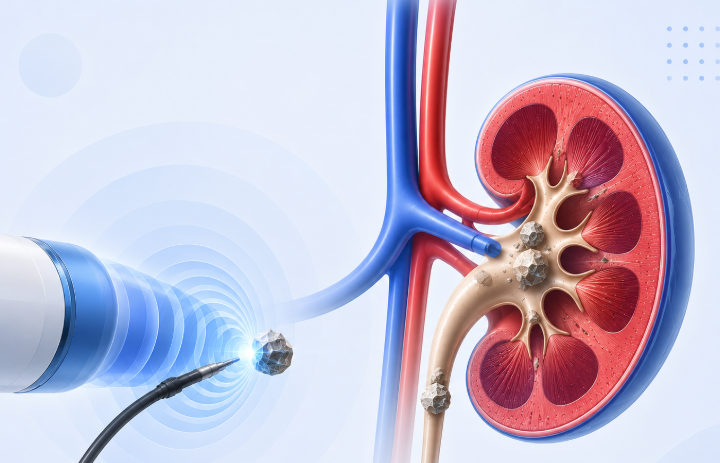
For smaller kidney stones that are well-positioned, ESWL treatment in Dehradun (Extracorporeal Shock Wave Lithotripsy) at Baluni Hospital Urology Department offers a completely non-invasive option. Focused shock waves are directed at the stone from outside the body, breaking it into tiny fragments that can then pass naturally through urine.
This is usually done as a day-care procedure with no cuts or incisions involved, making it a good first choice for suitable stone sizes and locations before considering more invasive surgery.
Living with the fear of a stone recurring is exhausting, but you don't have to manage it alone. Visit Baluni Hospital for an accurate diagnosis and a treatment plan that's actually built around your specific stone, not a one-size-fits-all approach.
Frequently Asked Questions
1. Can kidney stones pass without surgery?
Yes, small stones, usually under 5-6mm, often pass naturally with good hydration and medication, though this depends on size and location.
2. What is the difference between PCNL and URS surgery?
PCNL is used for larger stones and involves a small tunnel through the back, while URS uses a scope through the natural urinary path and is typically used for ureteric stones.
3. Is ESWL painful?
Most patients tolerate ESWL well with mild sedation or pain relief, and it doesn't involve any incisions.
4. How long is the recovery after PCNL surgery?
Most patients are up and about within a couple of days, with full recovery typically taking one to two weeks.
5. Do kidney stones come back after treatment?
They can, especially without dietary changes and adequate hydration, which is why we focus on prevention alongside treatment.
6. What causes kidney stones?
Low water intake, high-oxalate or high-salt diets, obesity, and certain metabolic conditions are common contributing factors.
7. Which treatment is best for a 1.5 cm kidney stone?
This depends on the exact location, but options like URS or ESWL are commonly considered, and our doctors will recommend based on your scans.
8. Is PCNL a major surgery?
It's minimally invasive compared to traditional open surgery, performed through a small tunnel, with most patients discharged within a couple of days.
9. How do I know if I have a kidney stone?
Sharp, wave-like pain in the back or side, blood in urine, nausea, or burning during urination are common signs worth getting checked.
10. Can drinking more water prevent kidney stones?
Yes, adequate hydration is one of the most effective ways to reduce the risk of stone formation and recurrence.
Register Online Before You Arrive.
Reserve your spot now and avoid waiting. We look forward to assisting you!
Book an Appointment